

Dave Ramsey Baby Steps: Do They Really Work?

Some products in this article are from our partners. Read our Advertiser Discloser.
Dave Ramsey is a world-renowned personal finance expert who created the seven baby steps to help people get their finances in order. But do the Dave Ramsey Baby Steps Really Work? Let’s break it down in a few easy-to-follow steps.
These steps helped me pay off $52,000 of consumer debt in 18 months. In this article, I will go over Dave Ramsey’s baby steps in detail. I’ll explain how they work, what you should look out for, and how they will help you achieve financial freedom.
Table of Contents
Who Is Dave Ramsey?
Dave Ramsey is a personal finance expert best known for his popular radio show, The Ramsey Show. It is syndicated nationally in the United States on over 600 radio stations and has over 16 million weekly listeners.
He is also behind Financial Peace University and the popular budgeting app, EveryDollar, which helps people stay on track when they follow his baby steps. Lastly, Dave Ramsey is a New York Times best-selling author of multiple books
What Are the Dave Ramsey Baby Steps?
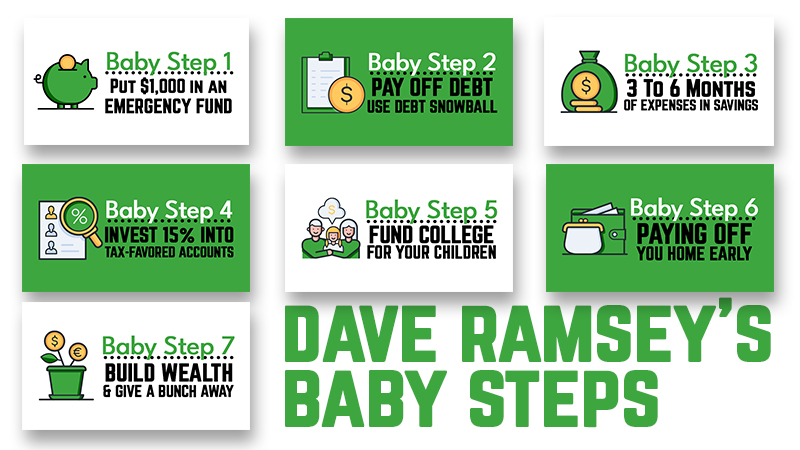
| Baby Step | Action |
| 1 | $1,000 in an Emergency Fund |
| 2 | Pay off debt using the Debt Snowball Method |
| 3 | Put 3 to 6 months of expenses in savings |
| 4 | Invest 15% of household income into retirement accounts |
| 5 | Fund college for children |
| 6 | Pay off your home early |
| 7 | Build wealth and give a bunch away |
My Video Review of Dave Ramsey’s Baby Steps

The Breakdown of Dave Ramsey’s 7 Baby Steps
Ready to learn more details about each of Dave Ramsey’s Baby Steps? Let’s go! I want to help you figure out where you are in the process. This is important. Let’s start with a breakdown of what each Baby Step entails. See where you’re at and jump in on the step from there.
1. Save $1,000
Dave calls this step the “starter emergency fund.” It might seem silly to start by saving $1,000. After all, you could use that money to reduce debt.
Dave’s logic behind the emergency fund baby step:
“Unexpected expenses happen to everyone. And for some reason, they tend to happen more when you’ve just committed to getting out of debt. To avoid being tempted to use your credit cards to handle these unexpected costs, save a quick $1,000 and put it aside as a buffer from those emergencies.”
So what happens if you’re paying off debt and have an emergency? Use some of the money in your starter emergency fund. Stop paying extra on your debt for now. Use the fund to pay cash for your emergency. Then, put any additional money into a high-yield savings account until it reaches $1,000 again.
Once it’s back at $1,000, you can resume the debt snowball. Handling emergencies this way will help ensure that your credit card balances continue to decline. They won’t go up due to emergencies.
2. Pay Off Debt
Paying off debt is the second part of Dave Ramsey’s Baby Steps. The debt avalanche (paying off debts according to the highest interest rate) will save money in the long run.
Examples of debt include:
- Credit card debt
- Student loan debt
- Personal loans
- Medical debt
- Loans from family or friends
However, the debt snowball method is often better for paying off debt. Why? Because it keeps people motivated. Getting debt-free is a long journey for many, whether you are paying off credit card debt or student loans.
What is the debt snowball method?
The debt snowball gives you quick wins from the start, which can motivate you to stay the course.
Here is how it works:
- List your debts from smallest to largest
- Make the minimum payment on all debts except the smallest one
- Put any extra funds toward the smallest debt until it’s paid in full
- Tackle the next smallest debt on your list with all your extra cash
- Repeat this until all debts are paid off
Check out our free debt snowball calculator here.
Bonus: Marking those smaller debts as “Paid in Full” faster will motivate you and give you faith that you can win the battle against debt.
Download the Debt Snowball form here.
3. Save 3 To 6 Months of Expenses For Emergencies

Ramsey’s next suggested baby step is to increase your emergency fund. You’ll save until it contains 3 to 6 months of household expenses. It might seem daunting to save that much money. However, Ramsey has a method for doing it quickly. If you’ve finished Baby Step 2, you are free of consumer debt. The only debt you have left should be mortgage debt.
Next, you’ll take the money you used to pay down debt. Don’t coast on your new, smaller payments. Instead, take the money and make a “payment” to yourself. Use the money that you were putting toward your debt snowball.
Make regular deposits to your savings account with it. Doing so should help you finish your emergency fund faster. An emergency fund will protect you and your family and provide a buffer against major financial emergencies. Troubles such as job layoffs and major home repairs won’t require credit cards; instead, you’ll pay for them with cash.
4. Maximize Retirement Investing

Look at you now! Your consumer debt is gone. You have a fully funded emergency fund. It contains 3 to 6 months’ worth of expenses. The next step is putting 15% of your income into tax-favored retirement accounts.
For 2025, this means contributing up to the legal maximum allowed by the IRS. That maximum is $23,500 per year for 401(k) s and $7,000 for IRAs. Ramsey suggests saving 15% of your income.
For instance, if your household income is $100,000, you would invest $15,000 annually. Note that those aged 50 and over can contribute more to retirement accounts.
- $7,500 to their 401(k)
- $1,000 to their IRA
These are called “catch-up” contributions. If you can make them, do it. Maxing out your retirement savings helps ensure your golden years are secure. The more you save, the more comfortable you’ll be.
5. Fund Kids’ College
There’s one thing I like about the college section of Dave Ramsey’s Baby Steps. Ramsey is clear that college doesn’t guarantee career success for your kids. He goes into great detail about the importance of calculating the cost vs. the benefit of college. Do this before you send your kid out to spend $25,000 a year on schooling.
Talking with your spouse is crucial during this step. Decide how much money you can afford to set aside for your kids’ education. The dollar amount you contribute to your children’s college fund is up to you. Be sure you research the different college-saving options as well.
Make sure that what you plan to contribute to your kid’s college education is affordable for your family. It’s also wise to have a specific education savings account. In addition, make your plan clear to your kids. They should know what to expect from you regarding college financing help.
As a final tip, consider college alternatives to contributing to your children’s college fund. You may end up saving significant money in the process.
6. Pay Off Home Mortgage
So you’ve paid off all of your consumer debt. You’ve got a fully funded emergency fund. You’re contributing at least 15 percent of your household income toward your retirement accounts. In addition, you have a plan for contributing to your kids’ college educations. What’s next? It’s time to pay off the mortgage faster.
Can you imagine being mortgage-free? Not owing anybody anything? They say the grass feels different under your feet when you own your home. Now, it’s time to find out. You’ve created a solid budget so that you know where your money goes. Now, take all of your extra funds. This includes funds that were going toward your debt snowball. And the amount you were putting into your emergency fund.
Put it all toward that mortgage loan, and get it paid off in full as soon as possible. Put any extra money toward the mortgage loan so you aren’t just making the minimum payments.
The extra money could include:
- Gifts
- Tax refunds
- Work bonuses
- Overtime pay
And any other money you don’t usually get. Since it’s unexpected money, you won’t miss it. Don’t spend it on other stuff. Instead, use it to pay off that mortgage. The less interest you pay to the bank, the more money you have. You can give it to worthy causes and use it to fulfill your dreams.
It’s your job to discover those dreams, which leads to Baby Step #7.
7. Build Wealth and Give
Here’s the best step! At least, in my humble opinion. You don’t owe money to anyone. And you’ve got a nice stockpile of savings.
What does that mean? It’s time to build wealth. Wealth-building can take many forms. You can invest in mutual funds. Or, you can invest in real estate. If you want, you can sock the money away in a high-interest account.
The goal is to put as much money as possible toward your financial goals. That might mean traveling the world. Or it might mean building your dream home. Maybe you want to live life as a philanthropist.
You’re completely debt-free. Now you’re working on having amassed a serious amount of wealth. The world is your oyster, and your dreams are unlimited. How does that sound? Good?
My Personal Experience
From my experience, I can say YES, the baby steps work. Not only did it help us become debt-free, but I have also seen other friends and family become debt-free. It does take work to get the results, but if you work the steps, the results will follow.
Summary
If you want financial freedom, start taking baby steps today. We used these steps personally to pay off our debt and start building wealth. If we can do it, you can too. Start taking the necessary steps to improve your finances today with the Dave Ramsey Baby Steps.
Recommended Reading: